
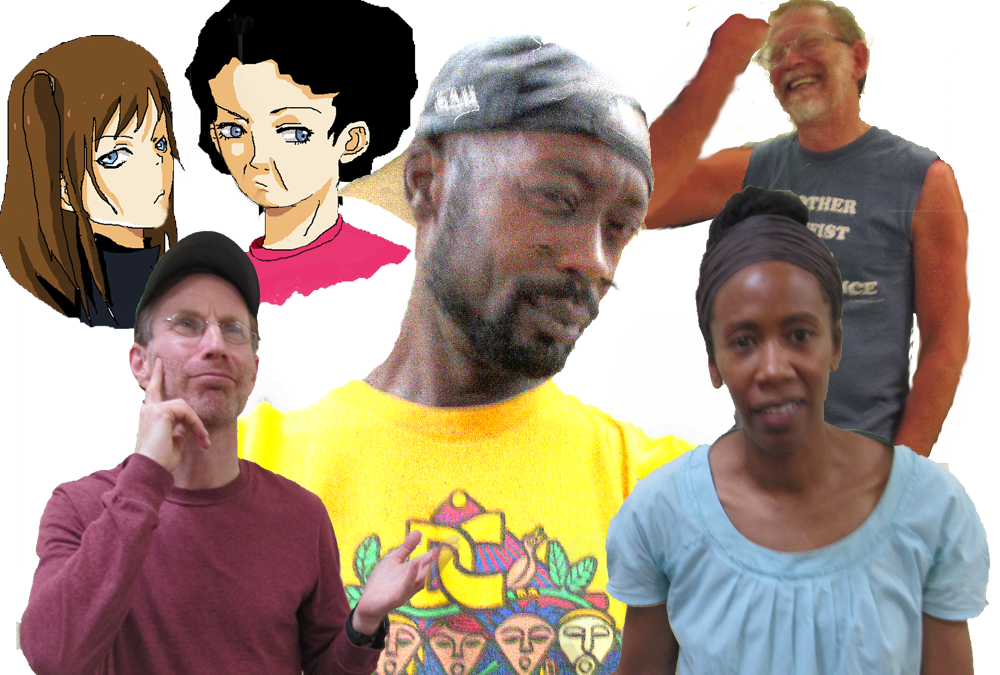
-“A romantic comedy about a community organizer juggling activism and family life…”
– “Don’t miss this compelling drama about Native American activists fighting an oil pipeline.”
– “Tune into the season premier of Occupy! the saga of a family involved in an epic movement for social and economic equality.”
– “The New York Times bestselling novel about a woman and her sisters who help organize a domestic workers’ union against tremendous odds!”
Yeah, sure…
How often do you hear about books, movies or programs featuring the lives, loves, adventures and accomplishments of social justice activists? For the most part we’re are absent from mainstream fiction, even the considerable number of works that focus on injustice. Activist characters pop up here and there, often highly stereotyped (See Activist Stereotype Unmasker). However, true-to-life, multidimensional portrayals of regular folks who fight for justice, peace, equality and the environment, activists the reader/viewer is invited to empathize with, root for, and gain deep understanding about, are hard to find.
And they’re likely to get harder. “Professional activists?” We will be seeing more attacks, and these attacks draw upon the deep well of ignorance that exists in the mainstream about what activists are, what we’re like and what we do. It is well known that accessible, nuanced depictions of groups of people counter ignorance and stereotypes about those groups, and it is no different for activists. Being seen as we truly are is a matter not just of respect for truth, but of protecting ourselves from the effects of ignorance.
Activists speak out in courtrooms and boardrooms. Confront politicians and officials. March and picket; occupy factories and parks; get fired, harassed, jailed, beaten and killed. Sit high up in trees and drop banners from skyscrapers. Demonstrate and debate. Face down soldiers and police. Strategize, sing, make banners and giant puppets. All the while, we deal with the contradictions, confusions, joys and complexities of trying to live according to our principles in the belly of the beast we’re trying to transform.
Where are the books, programs and movies about all this drama, this great raw material for plot, character, and wrestling with human issues at the edge? Why aren’t there more tales of everyday s/heroes making movements to fight fracking, corporations, police violence, neighborhood gentrifiers? Not just the occasional individual hero but the movements full of fascinating folk. The “why” is for other posts, but the “what,” the fact that activists are severely underrepresented, not to say misrepresented, in popular culture, is hard to deny.
Life in the Liberated Zone is about finding and fostering fiction featuring activists, in any genre, focusing on activist characters in movements around the world, opening windows into our diverse and culture.
We aspire to create a thorough, diverse list–a body of literature. We invite activists and the folks who love and want to read and/or write about them to:
- help compile a Fiction Featuring Activists reading list.
- create Fiction Featuring Activists
- join a Fiction Featuring Activists creators circle for people creating fiction in any medium to support one another
For the same reasons women, people of color, and other embattled cultures create bodies of literature illuminating their everyday experiences, conflicts, feelings, settings and characters, we as activists also need more literature that opens windows into our ways of life. Portrayals of activists as extremist, dogmatic, self-righteous, silly, bad mothers, hypocrites, or any of the other negative stereotypes we’re tagged with in mainstream fiction—when we appear at all!—undermine our ideas, ourselves and our work. Countering invisibility and stereotyping is important not only for our own concept of ourselves, but to improve the climate and success of our work and confront the minimizing and “otherizing” of activists throughout mainstream literature and culture.
The phrase “we need to tell our own stories,” is often heard, and sharing experiences is indeed an extremely valuable way to learn from one another, deepen collective understanding and build community. However, while we activists produce an abundance of nonfiction documenting our struggles, leaders, issues and theories, as well as considerable visual art, poetry and music, it is harder to find fiction—books, plays, feature films or TV series—with well-crafted multidimensional protagonists engaged in activism, written by people who understand and embrace our values and our reality. Yet fiction possesses a unique ability to bring readers and viewers into the “worlds” it evokes, as well as reveal characters’ inner depths and dilemmas, and enable folks to understand and identify with them.
The aim of Life in the Liberated Zone is to produce “truthful fiction” about activists and to encourage production of this kind of fiction, in a variety of media, styles and genres, through FFA writing workshops, an activist writers’ circle (in formation) and Stories of our People (SOOP), which collects anecdotes of activists’ everyday lives, inspiring moments, challenges and conflicts to throw into the “SOOP” pot as ingredients to help cook up works of fiction woven from real elements of the lives, times, language and culture of folks who work for a just world. We hope to add to and bring attention to the importance of fiction with well-developed, well-rounded activist characters central to our stories, characters with whom readers can identify and through which they can experience the delights and dilemmas of activist life.
Life in the Liberated Zone’s first novel is Rainwood House Sings, Book I of a three-part “social justice mystery.” Rainwood House Sings portrays several activists living in a tumbledown historical house in Maryland lightly haunted by past local struggles for African American and women’s rights. The characters—a Mexican ex-union organizer who works as a University of Maryland campus groundskeeper, her book- and bat-loving nine-year-old granddaughter, and a community activist of Afro Caribbean descent who is fleeing an accusation of cop-shooting—tackle sexual and political harassment, racial profiling, religious confusion and the vagaries of an old house lightly haunted by past human rights struggles that took place within it. The characters eventually joining forces with other activists, neighbors and kids to launch a university workers’ movement, a friendship club, a people’s history museum and a modern-day Underground Railroad stop.
A second facet of this literary activity focuses on children and young people creating collaborative works of fiction by and about youngsters working together to tackle social issues relevant to their communities. Our first book is a collective novel by children of Thomas Stone Elementary School in Mt. Rainier, MD, who worked together to write and illustrate Zombie Elementary, a story about children and nice kid zombies overcoming mutual fear and prejudice to tackle out-of-control kid zombies who are eating their schoolmates’ brains, trying to get smart without studying. The new work in progress of the Neighborhood Novelists is called The Imagination Club.We hope to work with young people in different localities, and encourage literacy teachers to learn and use this participatory creative writing process with their students.
Aimed primarily at teens and young adults, a third focus of Life in the Liberated Zone Literature is to produce works of fiction about becoming an activist, offering sympathetic yet honest views of this experience. Our initiating book is The Educación of Julia, a novel-memoir by Juliana Barnet about becoming an activist in Mexico.
LLZ Publishing welcomes any style and genre, as long as the story is engaging, readable while giving a destereotyped (“to destereotype” needs to be a verb, though spell-check dislikes it). Our colonized minds are full of stereotypes, which creep into our writing regardless of how progressive and conscious we are. At LLZ Publishing “destereotyping” will be an editing step like editing for consistency, voice, spelling or other aspects of good writing. picture of activists thinking, feeling, interacting and grappling with real challenges,