
LLZ Concepts
Some terms important to this site
Activists
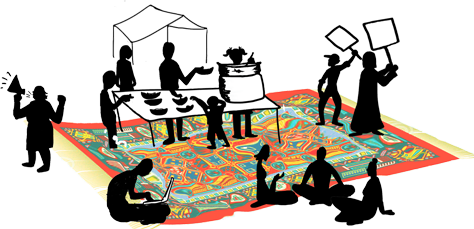
We are the world-wide grab-bag of boat-rockers, neck-sticker-outers, city-hall-fighters, tree-huggers, community-builders, movement-makers, organizers, agitators, rabble-rousers, arguers, word-flingers and art-makers struggling to create a just and compassionate world.
Some of us call ourselves revolutionaries, radicals, rebels, dissidents. We may identify with particular ideologies, and these may put us at odds with one another, not to mention with the dominant ideology.
READ MORE
What is common among us is that we step out of our private lives into the public sphere, to struggle alongside our peers for justice, equality, human rights and good treatment. While we generally focus on certain issues, constituencies and areas, we believe that the above principles apply to everyone equally, and that no one is “more equal than others.”
In the belly of the beast our principles and our practice are in constant tension, but we are always reaching to open and expand the liberated zones where we can be the change we want to see.
“We are the 99%” is a compelling truth on many levels. At the same time, activists, we who step or stumble into the public sphere to work for social transformation, are actually a small minority. An essential one with influence far beyond our numbers.
Fiction Featuring Activists
How often do you read a story, see a movie or watch a TV program about exciting movements for social justice, with complex sympathetic activist characters? Not very often, I’m guessing, especially ones set in the present.
And even when activists do appear, we’re often portrayed as extremist, dogmatic, self-righteous, silly or sacey; we’re shown as bad mothers, hypocrites, and other negative stereotypes.
READ MORE
Such minimizing, “otherizing” and stereotyping undermine our ideas, ourselves and our work. For the same reasons women, people of color, and other embattled cultures create bodies of literature illuminating their everyday experiences, conflicts, feelings, settings and characters, we as activists also need more literature that opens windows into our ways of life.
Countering invisibility and stereotyping is important not only for our own concept of ourselves, but to improve the climate and success of our work.
Activist Culture
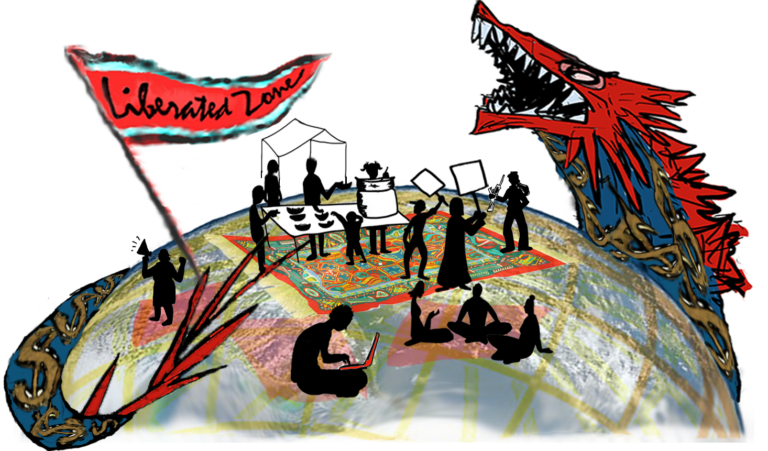
We regard and interact with the world in ways that distinguish us from non-activists, whose lives are not permeated with the experience of living in the belly of the beast while struggling to transform it.
READ MORE
While tremendously diverse, we nonetheless share many distinct cultural realities—risks, responsibilities, joys, beliefs, attitudes, connections, rituals, humor, history, principles, ideologies, role models, vocabulary, and more.
As with all cultures targeted by oppression and repression, consciousness of our cultural identity as activists is crucial to defending ourselves individually and collectively, as well as to gaining full awareness of all dimensions of our struggle. And to living whole and satisfying lives.
Liberated Zones
Around the world and throughout history, struggles of liberation, insurgency and resistance forces liberate territory and create liberated zones. In these spaces participants in the struggle set up encampments to live, rest, refuel and retreat; people connected to the struggle organize life, almost always collectively, gather, store, cook and distribute food, and even grow and trade food, and other resources. They organize literacy campaigns, assemblies, trainings, discussions, cultural manifestations, rituals, and speakouts.
READ MORE
These physical, social, and metaphysical spaces enable us to recover from our exertions, take care of our needs (as much as possible in keeping with our values), and to imagine, discuss and at times carry out trial runs of the new society we hope eventually to bring forth out of the old.