
Activists live in the belly of the beast we’re struggling to transform.We know better ways of being, we try some them out, and we feel bad that we can’t always follow through or make changes in all aspects of our lives. We believe in equality, justice and participation, but the institutions we are part of–our workplace, school, family or almost any other–are very unlikely to be democracies. We want to consume only things made with respect for the earth and its inhabitants, but opportunities to do so are few, and when they do exist economic inequality often means we can’t afford them.
We know race is a social construct meant to divide and rule all of us. Gender inequity, and other social divisions, each unique in some aspects, have this basic function as well. We know this, but in our daily lives these divisions, which are after all basic to keeping society in its current state, operate within and between us all the time.
We see this, deplore it, try to address it in various ways [link to some articles]. Different aspects come and go, whether we’re talking about how white people act, how men act, class, etc. Acting out oppression we’ve been conditioned into over the years, at one and the same time our conscious words condemn it, is frustrating, maddening, and extremely eroding of trust. It makes people on the short end of such interactions—women, people of the global majority—feel not only misused, as with any racist or sexist treatment, but also betrayed, and that the activist comrade or community doing this is hypocritical and untrustworthy. A perfect instance of how these insidious these oppressions are: even the denouncing and the critique of them can be divisive.
Confronting our automatic reproduction of the oppression we’re seeking to overcome is critical. But simply denouncing, calling out, oppressive behavior is generally insufficient and, by itself, ineffective. Confronting oppressive behavior of individuals connected to our struggle is particularly important, yet fraught with issues and often counterproductive.
How to frame the problem of dealing in detail, in reality on the ground, with the concrete instances of all the isms we fight, when they are in our midst and inside our minds?
GG: Colonizing our minds, in fact.
JB: Good to see you’re here helping me write this, Granny Gus.
GG: Any time!
SP: Literally.
JB: It’s exciting to see that people are starting to do this more, or at least, wrestling with it quite a bit, recognizing that our society, including ourselves, is permeated with oppression, inequality and exploitation, and that from the outset confronting this and creating new conditions must be a cornerstone, not an add-on.
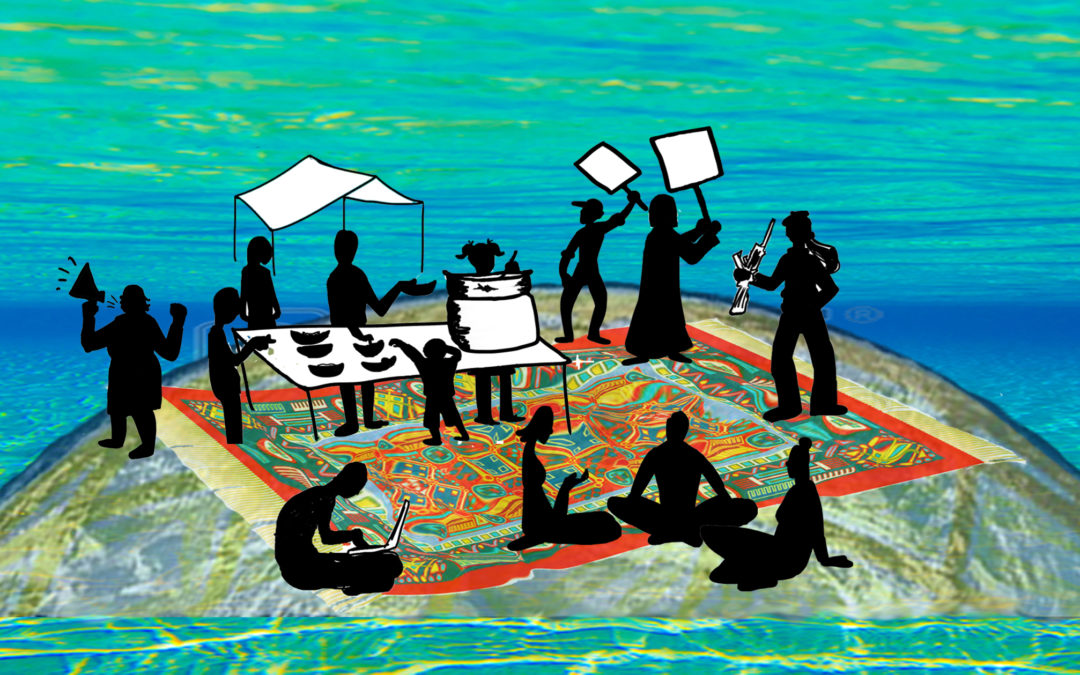
It is like building a community in the ocean. You would not set up the physical plant, the programs, the membership process, the routines, select the issues, choose the furniture and then, , say, oh yes, and by the way we need to deal with the fact that we’re going to be doing all this underwater.
That would be ridiculous. It is just as futile to attempt to operate in this society, which is of course what we’re doing as we work to change it, without countering structural oppression and inequality in the core of the work. It is a simple fact that if this is not done, the default is to reproduce on the ground, in our work and interactions, the oppressive relations that surround us as completely as air—or water if we were in the ocean.
Our new culture needs to make a collective, ongoing habit of consciousness to notice how we are reproducing oppressions in our midst, and take positive, daily, non-blaming but firm measures to counter them.