
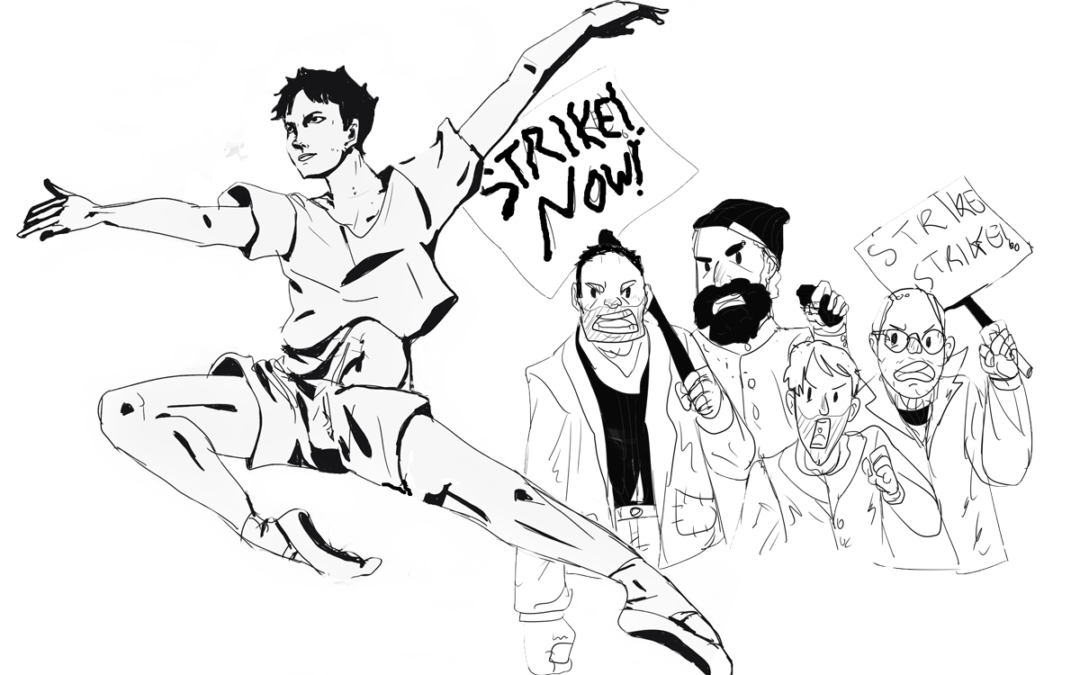
Billy Elliot – Soaring Dancer, Sinking Union
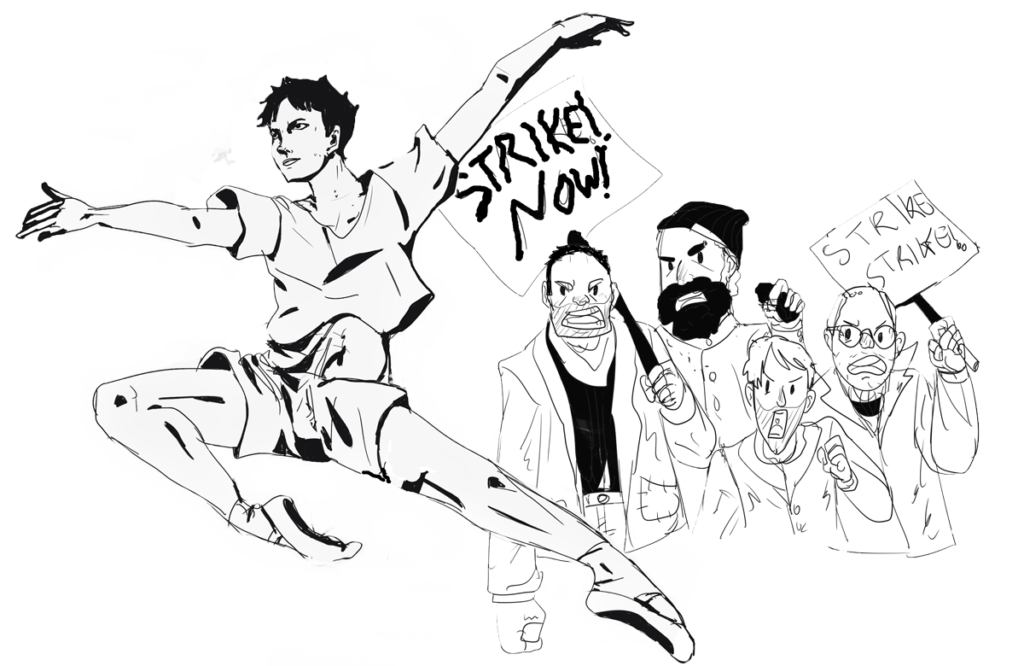
Activists know that workers and labor organizing get attacked from many directions, but we don’t generally expect assault from popular fiction. Nonetheless, movies, TV, novels and other storytelling formats can be potent weapons against unions and other social justice organizing, in most cases not because writers and filmmakers intentionally malign them but because their portrayals are full of unexamined stereotypes.
Billy Elliot a film about a young miner’s son who aspires to be a ballet dancer, is set in a poor Northern England town during the year-long coal miners’ strike of 1984-85, in the harsh climate of Margaret Thatcher’s Britain. The striking Miners Union, the local labor leaders and strikers have an important role in the story, which is more than can be said about most films and other forms of fiction where workers’ struggles are nonexistent
However, while very engaging as a family story and dance film, Billy Elliot becomes tone-deaf when it comes to portraying the strike, the union, and the workers.
A workers’ strike is a terrific setting for fiction, full of conflict, heroism, suspense, ingenuity, pain, triumph and loss. Unfortunately, in the film Billy Elliot the strike is merely an adverse backdrop.
Eleven-year-old Billy Elliot (Jamie Bell) hates taking boxing lessons. Under the influence of his musical dead mother, he is drawn instead to the ballet class held in the same Northern England small-town rec room, he begins attending dancing class with the tutu-wearing girls and soon becomes the ballet teacher’s star pupil.
Billy’s father and older brother are miners who along with their union brothers are participants in the year-long coal miners’ strike. Upon discovering Billy’s dancing they are angry and contemptuous until they see him dance. Once his secret is out and the shouting is over, the film centers on whether Billy will get into a famous London ballet school, and whether the father can afford the tuition.
Billy Elliot is portrayed very sympathetically as a regular kind of boy who wants to dance. The film gives plenty of attention to the inner turmoil of the father around his son’s “sissy” inclination, and around his efforts to pay for it. It gives a balanced look at the class tension between the father–at first appalled by Billy’s dancing, and then ashamed of his inability to pay for it–and the middle class teacher who wants to support Billy’s gift.
The film also touches on, in a few brief scenes, how Billy tangles with gender pigeonholes in his relationships with his gay best friend and the teacher’s sexually precocious daughter, expressing his confusion, and his anger at the rigid male stereotypes his father and brother expect him to conform to, through his spectacular dancing.
Unfortunately, such nuance and attention to detail are not in evidence in the portrayal of the miners’ strike. A constant presence throughout the movie, the union, the strike, and the struggling workers are merely a backdrop, part of the “adverse circumstances” Billy must overcome.
We see the family suffering, realistically, the economic hardships of the strike, but we see none of the inspiration and unity that kept the miners together in the struggle for over a year. We never learn why the strike happened, we never hear the miners discuss it, either within Billy’s family–even though the brother is a strike leader–or in any group scene.
We see several instances of miners yelling at workers who cross the picket lines–eventually including Billy’s anguished father. We watch with distaste as workers fling eggs at the strikebreakers’ bus while the father sits inside it—and we can’t help thinking eggs a weird choice of missile for people who are hungry.
The scab-striker conflict is often a key moment in a strike, and the clash between Billy’s father and older brother clash lends itself perfectly to fiction, which is great for personalizing a larger issue in order to understand the nuances, effects and motivations of each side. We are shown the point of view of the father and we easily identify with how torn he feels between loyalty to his union and his need to support his family (even though, as Roger Ebert pointed out, it’s highly unlikely that a worker would scab in this way).
But the movie does not invite us to look with similar understanding into the mind of the brother, the union leader. This character wouldn’t need to be portrayed as an accomplished conversationalist to spell out, or even spit out in his usual mean tone, alternatives to strike-breaking that the father might have sought out. We only see him preventing his father from going through with it, and witness strong emotion between them but no further information to help us understand their bond within the union. Nor do we get to hear the son’s reasons for becoming a strike leader, or see into his heart what he has risked and what he has gained in the movement. Nor yet the inspiration and exhilaration he might feel in his role.
After their change of heart, the brother and father become devoted to furthering the son’s goal of studying at the Royale Ballet. We see the wrenching moment of the father pawning his dead wife’s jewelry, and a prolonged conversation with Billy’s teacher about her giving him help. When the father, overjoyed that his son has been accepted into the academy, races down to the union hall to tell his brothers—no women appear in any union scene—the miners regard him morosely and take the wind out of his sails by announcing that the strike is over, that “the union caved.”
The strike is a constant presence throughout the movie, but the miners speak in barely intelligible growls and shouts, and we learn next to nothing about them or the movement that has gripped their community. The wrenching failure of the strike, which could not be in greater contrast to the personal success of Billy, leaves a bad taste in our mouths about the union, as well as the stereotype of the union as a manipulative entity separate from the workers, leading them on, bringing hardship, leaving them in the lurch. The workers, too, remain inarticulate, angry victims. We are told that they are striking against the mining company, but we never see them on screen confronting company representatives or discussing their demands, strategy or the goals of this long and arduous struggle. The conflicts we’re actually shown on screen are among the workers themselves, as they attack scabs, art, and the union itself, since bosses or officials do not appear.
This story is about the triumph of the human spirit. Billy’s individual spirit while ignoring the solidarity and spirit of the workers who kept the strike going. Transformation occurs when the father and the brother have a moment of revelation and come to support instead of condemn Billy for dancing ballet. But we do not get to see anything of the personal journey of participating in a union on strike. In fact, from this movie everything about that participation is at best a bleak necessity and at worst misplaced trust in a corrupt betrayer–as unions are so often depicted as being.At the very end of the movie, to complete the opposing trajectories, Billy soars into his finale soon after a scene where we hear one nameless worker say to another, “the union caved.” Followed by a brief tableau of inarticulate despair. Again, no context or reasons given for this critical development in the main social event running through the film.
I love the idea of a movie that takes on the difficult and complex relationship between unions and art. Another theme ripe for exploration is workers and gender identify–and in a subsequent post Activist Stereotype Buster will take on Pride, which focuses on this very topic, around the very same miners’ strike.
But we need movies–and books and programs–that deal realistically, fairly and sympathetically, with real understanding, and which center on activists who are multi-dimensional people we can get close to. We need films that speak about art and individual freedom and inspiration without contrasting them–consciously or not–against anti-worker, anti-union stereotypes, which unfortunately abound in Billy Elliot. Whether they are included consciously is irrelevant; they have been instilled in our collective consciousness by the dominant culture and will sprout on their own unless a stern stereotype-busting eye is turned upon them.
Fiction invites you into the world and the minds of the characters, and thus has tremendous ability to influence one’s feelings towards them. Having an opportunity to ihelp people understand and identify with union folks, even briefly, and not taking it, is unfortunate.
Billy Elliot does get some points for making a strike, a union and a workers’ struggle key elements in the story. But it falls far short of being a full and fair portrayal of the strike and the workers themselves. And yet it could so easily have been done, without changing the main story; merely taking a bit of time to clarify and nuance the portrayals of the workers, to let them speak and converse among each other, instead of only growl, gripe and yell. Nor would it have meant huge, preachy swaths of narration; merely allow the union workers a few enlightening conversations of the kind that real workers, especially those who organize and sustain a strike together, actually have all the time.
I can envision many personal dramas taking place in the context of a workers’ strike. It is a terrific setting, full of conflict, heroism, suspense, creativity, ingenuity, pain, triumph and loss. Plenty of possibilities for personal drama, transformation, romance, spiritual awakening. I hope in the future to hear of more works of fiction, whether in prose or on screen, that sympathetically and accurately depict these exciting collective human endeavors.
– Juliana Barnet
– Artwork: Sophie Barnet-Higgins w/JB