
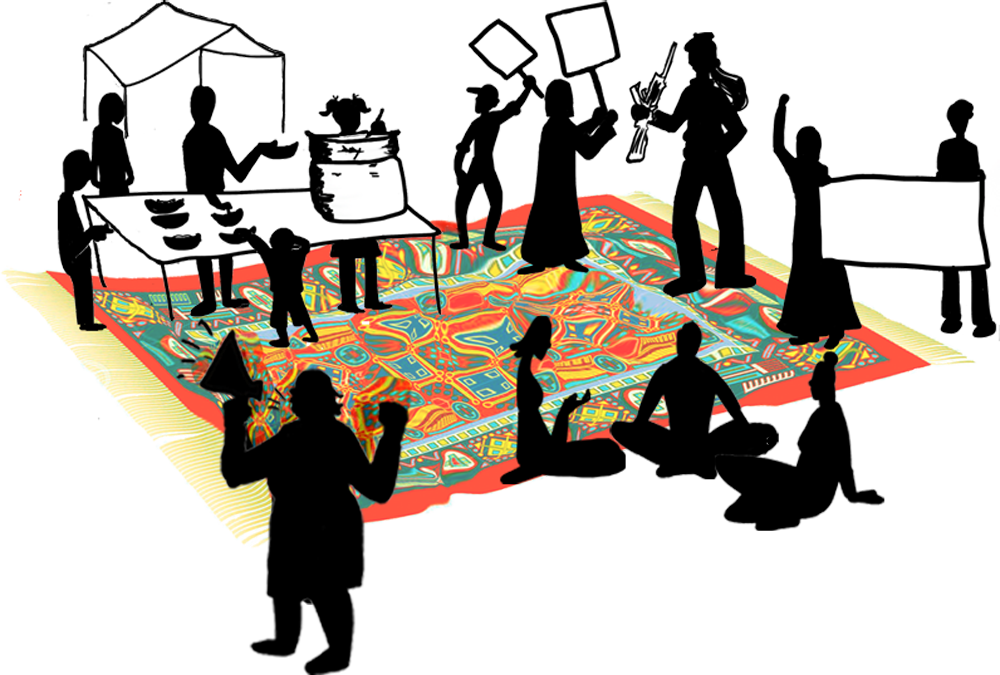
And What is Activist Culture?
We are the global grab-bag of boat-rockers, neck-sticker-outers, city-hall-fighters, tree-huggers, community-builders, trouble-makers, thought-provokers, rabble-rousers, visionaries, and gadflies. Diverse as we are, we share specific values, attitudes, connections, rituals, humor, history, principles, risks, responsibilities, triumphs, role models, vocabulary, and ways of regarding and interacting with each other and the world.
We have common experiences, starting with the day we each stepped (or leaped or were pushed) out of our private lives into a larger arena in pursuit of justice for our communities and the world. As activists we live with unique joys and risks, in the face of consequences ranging from uncomfortable to dire.
Why is this important? Activists are averse to navel gazing, and focusing on our own experience might sound like just that. But greater awareness of our culture can help us take better care of ourselves, our relationships and communities, as well as better defend ourselves and our work from the wide variety of attacks and underminings to which we are continually subject. It can aid us in apprehending long term, subtle trends, advances and weakness in our midst.
Part of activist culture is recognizing the specific ways we are targeted, including attacks of many varieties for speaking out and taking leadership; inadequate (or nonexistent) pay, benefits, recognition or security for activist work; stereotyping and marginalization; divide-and-conquer tactics and other forms of manipulation. And, of course, direct repression and violence.
Which we internalize, in our own brand of internalized oppression: self blame, internal divisions and the reproduction of societal oppressions—race, gender, class, etc.—a situation that can be particularly painful among folk devoted to ending these very oppressions. All this on top of the daily dissonance of being round pegs squeezing into square holes.
Despite the stereotype of activists as heartless manipulators who toss others into the fray while hanging back, we are generally the first to try out what we fight for. LLZ seeks to deepen understanding of these endeavors and how they help us gain emotional, mental and practical experience in creating alternative social relations.
Activist Identity
“Activist” is a bland and problematic label, but seems the most widely accepted term for the motley group described above. Whatever can be said against it, the term “activist” does get at the basic nature of our culture: taking action, of being agents for change. Activism is an identity we want to own with pride and encourage more people to choose. Identity consciousness is an important facet of struggle, for self-awareness, self-defense and seeing ourselves as part of a whole regardless of the time, place or state of the movement or of our individual experience in it. The more we understand our own actions, reactions and roles in this larger community, the better we can act, face pressure and risk, counter division and isolation, and connect.
Franz Fanon asserts that “culture is at the very core of the struggle for freedom,” [quoted in Jill L. Matus, Toni Morrison, p.11 ] LLZ focuses on our own culture as activists, not an itinerant loose collection of individuals but a true people with identity, deep connection and, shared history, reality and future.